Battery Support During Vehicle Diagnostics: Charger, Maintainer or Programming Supply?

In this guide
A weak 12-volt battery can interrupt communication with a diagnostic scanner, trigger misleading module warnings or compromise a sensitive programming session. The solution is not automatically a cheap trickle charger. A charger, a long-term maintainer and a regulated diagnostic/programming power supply serve different tasks.
Quick verdict: For routine code reading on a healthy vehicle, follow the scanner and vehicle makers’ normal power guidance. For extended workshop diagnosis, select battery-support equipment rated for the specific battery chemistry, voltage system and anticipated electrical load. For ECU programming, use the vehicle/OEM software’s specified stabilized supply and have qualified personnel carry out the procedure. Do not assume a consumer maintainer can supply the necessary current or hold voltage stable under changing load.
What each product class actually does
| Equipment | Normal intended role | What it does not automatically establish |
|---|---|---|
| Battery maintainer | Preserve charge during storage or low-load periods | Adequate support for high-load programming |
| Battery charger | Replenish charge according to battery type and charging mode | Stable regulated voltage under every diagnostic load |
| Workshop support supply | Support a live vehicle electrical system during specified tests | Safe compatibility with all 12V or 24V battery systems |
| Jump starter | Provide short-duration engine-start assistance | Continuous stable power during programming |
For example, CTEK sells the PRO25S NA as a 12V workshop charger with a supply mode for diagnostics. That is evidence of a specific product type, not proof that a particular vehicle’s programming procedure permits it or that 25A is adequate for all workshop loads. Read its current manual and the OEM tool specification before using any support supply.
Why the car’s power state changes the demand
A vehicle with the ignition on, interior fans operating, multiple control modules awake and a scanner connected can draw materially more current than a parked car in sleep mode. Turning off nonessential loads may be part of manufacturer service instructions, but changing vehicle state during a diagnostic routine can also alter test validity. Follow the manufacturer’s exact setup requirements instead of applying a universal recipe.
With hybrid or electric vehicles, the 12V accessory system still matters for diagnostic communications, but high-voltage battery components require additional training and isolation practices. No general buying guide should describe unqualified access to high-voltage service connectors or cells. See OBD2 adapters for hybrids and EVs for the software coverage distinction.
How to choose without guessing a voltage target
Record the vehicle’s nominal electrical system and battery chemistry, then check whether the vehicle service procedure names a required regulated voltage range and current capacity. Check the charger’s applicable modes, permitted battery types, overtemperature behavior, clamps, power source and whether the manufacturer approves it for use while the vehicle is connected. If a stated requirement cannot be confirmed, do not perform the programming work on the assumption that a device advertised as “smart” or “professional” is sufficient.
A generic 12V trickle charger can be fine for storage maintenance yet unsuitable for a long programming session. A high-current shop support unit may be inappropriate for small batteries or unsupported chemistries. Selection should follow ratings and the manufacturer documentation, not popularity or broad price bands.
Checklist before purchasing support equipment
| Item | Verify |
|---|---|
| Vehicle | Correct battery system and OEM service instructions |
| Battery | Chemistry, size and service condition |
| Intended job | Ordinary scanning, live-data session, adaptation or programming |
| Power device | Current capacity, stabilized supply behavior and allowed modes |
| Electrical setup | Safe leads, clear work area and manufacturer-approved connections |
| User competence | Training and authorized service procedure for programming |
| Software/tool | Exact scanner/vehicle manufacturer’s power requirements |
No active affiliate buttons are included because the appropriate equipment and current Amazon US offers have not been verified for any specific vehicle or procedure.
When to stop and use professional service
If modules repeatedly drop offline, the tool reports low supply voltage, the vehicle has electrical damage, or the job involves safety systems or module reflashing, pause and consult a qualified technician. Repeated failed programming attempts can have expensive consequences; an online article cannot validate the electrical and procedural conditions required for a particular vehicle.
A real buying comparison: maintainer versus workshop supply
Consider a driver whose vehicle sits for weeks between uses. A suitable battery maintainer may be an appropriate storage tool when selected for the battery type and used according to the manufacturer’s instructions. Now consider a workshop preparing a vehicle for a long OEM programming session. Modules may be awake, electrical loads can vary and a failed voltage supply can interrupt software operations. The maintainer’s low charging current and operating purpose may not meet that service requirement. Do not choose equipment by the word “smart charger” alone.
The tool manufacturer’s instructions may require an approved power supply with a specific output and regulation range. CTEK’s PRO25S NA illustrates a product marketed for workshop battery support and supply mode, but the product’s presence on a comparison page is not permission to use it for every programming job. The reader must verify current device specifications, battery compatibility and the vehicle-maker’s requirement.
Where batteries and diagnostic failures intersect
Symptoms that appear to be scanner faults—intermittent controller disconnects, unexpected resets, communication timeouts—can occur alongside poor vehicle supply conditions. They can also come from bad cables, software errors or unsupported modules. Avoid diagnosing a battery solely from one lost connection. A qualified technician may need an appropriate electrical inspection and documented voltage monitoring to find the cause. This guide does not provide live-voltage wiring instructions or programming procedures.
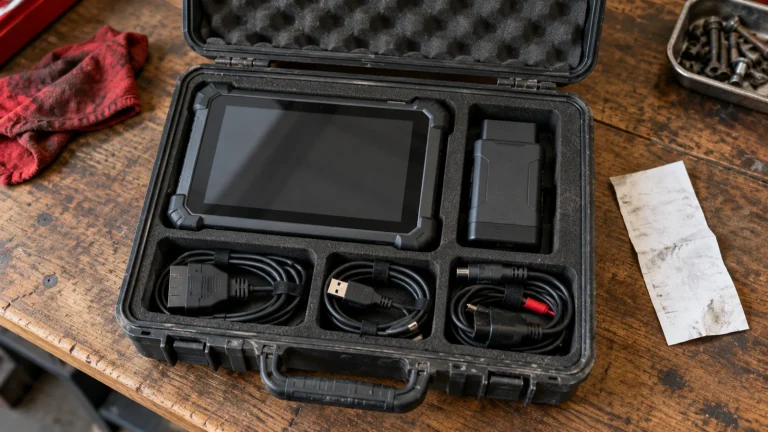
For a scanner purchase itself, verify whether the tablet has an internal battery, whether the VCI draws power from the vehicle port and whether the maker requires a charger during extended sessions. Those are different power sources. A fully charged tablet is not a substitute for healthy vehicle electrical power.
Battery chemistry and service scope deserve explicit documentation
A 12V lead-acid battery, an AGM battery and a lithium-based auxiliary system may have different charging requirements. A charger that supports one chemistry cannot be presumed suitable for every vehicle simply because the nominal voltage is similar. Check official battery and vehicle documents, not just marketplace category filters. The supply’s connectors and operating environment also matter; use approved connections and follow the manufacturer’s electrical-safety instructions.
If the intended task involves high-voltage hybrid or EV systems, this 12V supply comparison is not authorization to work on traction-battery circuits. Those systems require manufacturer-specific procedures and training. Use a 12V battery-support device only for the low-voltage applications expressly documented by its manufacturer.
FAQs
Can a battery maintainer substitute for a programming power supply?
Not without confirmation that its supported output and regulation meet the vehicle/OEM procedure’s requirements. The devices are designed for different use cases.
Is a jump starter suitable for scanner programming?
Do not assume so. A boost device is designed primarily for starting assistance, not necessarily sustained regulated power during an extended software process.
Do I need external battery support just to read a code?
Not always. Use the vehicle and scanner makers’ ordinary operating guidance. A clearly weak battery can cause communication issues that should be addressed independently.
Final recommendation
Match the power-support device to the documented task and vehicle. For high-risk programming, follow the OEM-prescribed regulated supply requirements and use qualified service. Avoid recommending a specific charger on the strength of a generic “programming compatible” label alone.