Best Scan Tools for SRS Airbag Codes in 2026
In this guide
An illuminated airbag warning should not send a buyer shopping for a generic engine-code reader. The supplemental restraint system (SRS) uses vehicle-specific controllers and faults, so a tool that reads a check-engine code may not communicate with the airbag module at all. The correct purchase depends on the exact car, whether the device can read that car’s SRS diagnostic trouble codes (DTCs), and how the manufacturer documents the intended procedure.
Affiliate disclosure: As an Amazon Associate I earn from qualifying purchases.
Quick verdict: The Innova 5610 is a worthwhile first check for owners seeking a standalone handheld that explicitly includes SRS diagnostics and a vehicle-specific coverage checker. For broader wireless tablet diagnostics, investigate Autel MK900-BT and TOPDON ArtiDiag900 Lite, then compare TOPDON ArtiDiag900BT, XTOOL D7S, and XTOOL D8S for additional all-system capabilities. This is not a tested reliability ranking and none is approved for an unknown vehicle without coverage evidence.
Safety and evidence: Restraint systems can contain pyrotechnic components. Reading trouble codes is not permission to disconnect an inflator, handle deployed modules, or run a reset. Follow the vehicle manufacturer’s restraint-system service information. This article does not provide a repair or bypass procedure. The products below were selected from official published function lists, not road tests, and live Amazon offers were not confirmed.
Six candidate scanners compared
| Scanner | Published SRS evidence | Reader type | Why investigate | Mandatory verification |
|---|---|---|---|---|
| Innova 5610 | SRS code and enhanced-data categories | Wired handheld | Clear feature-level coverage checker | Exact vehicle, SRS DTC menu and market |
| Autel MK900-BT | All-system scan and airbag-module diagnostics in broader system coverage | Wireless tablet | Multiple vehicle systems and reports | Supported control units and functions |
| TOPDON ArtiDiag900 Lite | All-system scans and named airbag reset category | Wireless tablet | Focused service-menu buyer | Confirm code reading separately from reset |
| TOPDON ArtiDiag900BT | All-system diagnosis and broader service set | Wireless tablet | Shops with varied service needs | Actual SRS access and update costs |
| XTOOL D7S | All-system coverage includes SRS | Wired tablet | Diagnostic plus wider active tests | US version and vehicle-specific support |
| XTOOL D8S | Manufacturer lists SRS among all systems | Wired tablet | More advanced diagnostics beyond SRS | Supported model and procedures |
The columns describe manufacturer claims, not independently tested success rates. Published all-system access is not a guarantee of every possible airbag code or module variant. A code reset is a different operation from confirming the cause of the warning or deciding a restraint system is safe.
1. Innova 5610 — check this first for a handheld with explicit SRS support
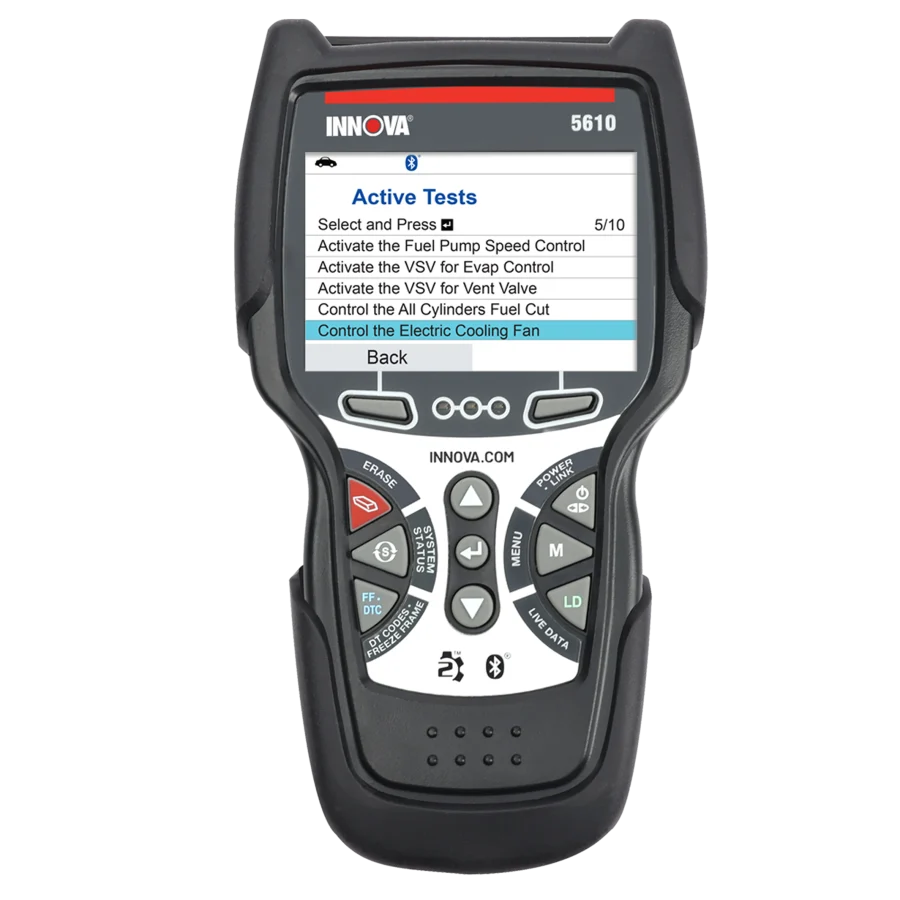
Innova’s official product matrix differentiates the 5610 from basic readers by listing SRS codes, a network scan, OEM live data, and bidirectional controls. More importantly, its coverage-checker instructions show the process for selecting a scanner and vehicle and inspecting engine, ABS, SRS, and other diagnostics individually. That is stronger purchase evidence than a generic phrase such as “works with 1996+ cars.”
The benefit of the 5610 is not that it can repair airbags—it cannot do so automatically. Its potential value is giving the owner a more specific starting point than reading a powertrain P-code. If your goal is primarily to retrieve restraint-module fault information and work with a qualified technician, a compatible handheld may be enough. Its on-device format also does not require buying a full-size tablet solely for SRS research.
Check before ordering: confirm the market and model year, the SRS diagnostic category, whether the coverage checker lists codes versus OEM enhanced data, and whether any relevant adapter is required. Also review software updating requirements. An aftermarket DTC description can be a useful lead, but the actual diagnosis remains vehicle-specific.
Not appropriate for: a buyer expecting every occupant-classification initialization, crash-data issue, module programming task, or deployment-related repair to be solved by a generic SRS reset. Those jobs may require factory information, special tools, or professional service.
2. Autel MaxiCOM MK900-BT — an all-system tablet for wider investigation

Autel identifies the MK900-BT as a wireless all-system diagnostic tablet capable of scanning control units and displaying codes and live data from supported vehicle systems. Its manual explains automatic scans and selection of individual control units. The tool’s pre-scan/post-scan reporting can help document which faults existed before and after an authorized repair—an important distinction when more than one fault appears.
A full-system scan is useful if an airbag warning is accompanied by voltage, body-control, seat, or communication-related faults. Still, a generic scan summary will not always show the data needed for the specific SRS task. The manufacturer must substantiate access to the exact airbag controller and requested function for the chosen car.
Buyer fit: owners maintaining several cars who want ABS, transmission, and other diagnostic categories alongside SRS. Purchase risk: paying for a broad tool without checking the one critical restraint function. Compare its ongoing update terms with your intended ownership period rather than assuming newer software guarantees SRS coverage.
3. TOPDON ArtiDiag900 Lite — distinguish the airbag menu from real coverage
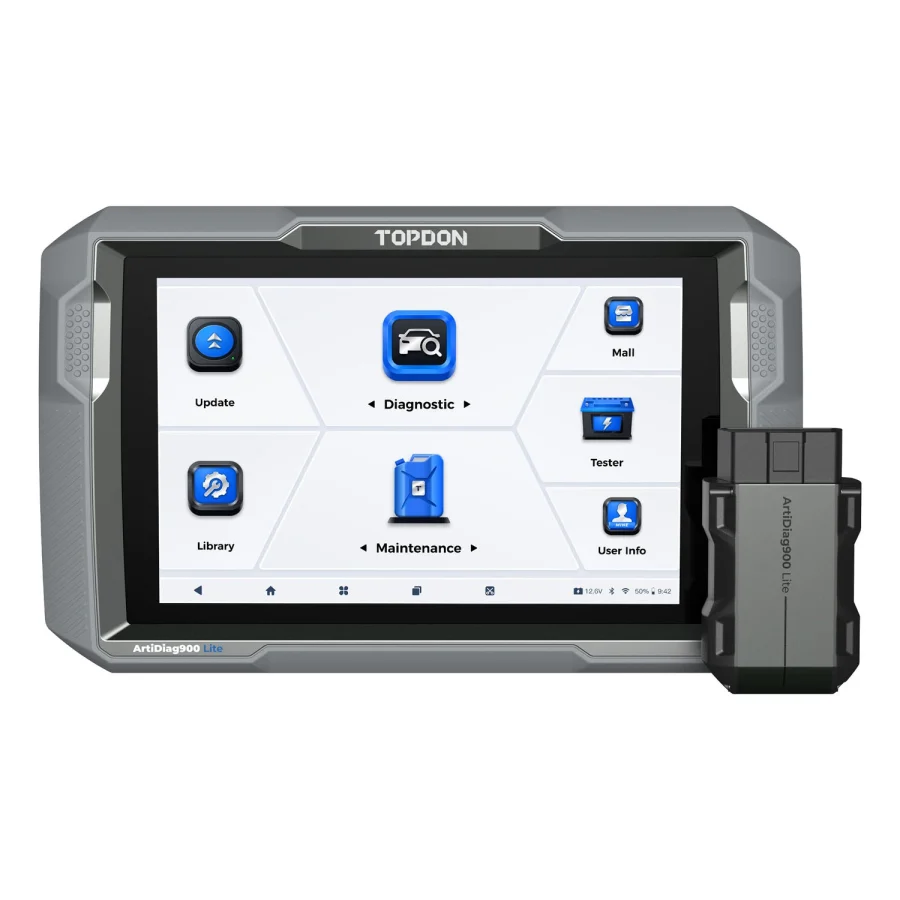
TOPDON’s current US product page lists all-system diagnosis and an “Airbag Reset” maintenance category. That makes this model worth investigating, but the label does not describe every possible restraint-system fault or repair. A menu category is not a coverage certificate for a particular seat module or occupant sensor.
The ArtiDiag900 Lite is an eight-inch wireless tablet positioned around a narrower eight-function named service set. Its product family also advertises bidirectional tests. A buyer should look up both ordinary SRS code reading and any requested service procedure separately. The Lite’s update policy should be checked on the current US page, rather than relying on outdated reseller cards.
Buyer fit: someone with a specific supported vehicle whose diagnostic needs extend beyond an SRS warning. Purchase risk: interpreting marketing shorthand as full authorization to clear faults without understanding the source of the warning.
4. TOPDON ArtiDiag900BT — broader general maintenance scope

TOPDON advertises all-system diagnostics, wireless vehicle communication, 28 named service functions, and ECU coding capabilities on the ArtiDiag900BT. Compared with the Lite, the attraction is the wider general-purpose service portfolio. That wider menu is relevant when the owner also needs steering-angle service, battery-related functions, or other maintenance tasks on supported vehicles.
TOPDON US currently lists two years of included updates and a paid annual renewal for this model. Renewal cost is relevant for owners managing changing makes and model years. It is not inherently necessary for every owner to renew: existing installed functions may differ from updated coverage. Read the actual policy and request a precise explanation for your device and intended vehicles.
Buyer fit: users with a broad, documented multi-vehicle workload. Purchase risk: paying more for unrelated services when the SRS task is not confirmed.
5. XTOOL D7S — wired multi-system candidate

XTOOL’s official D7S page names engine, ABS, SRS, and transmission among its all-system diagnostics. It also advertises active tests, multiple service routines, and a multi-year software-update period. The wired connection may suit owners who prefer a direct cable during stationary work.
Check the actual version: product pages sometimes include model revisions and a mix of US-specific feature caveats. A scanner advertising an airbag category does not necessarily implement an exact initialization or replacement procedure for a particular car. XTOOL also publishes US-specific qualifications for some Volkswagen-group guided functionality, which should not be generalized to every SRS function.
Buyer fit: DIY owners who have confirmed the required SRS access and need wider diagnostics too. Purchase risk: confusing general SRS diagnostics with post-repair safety validation.
6. XTOOL D8S — higher-end diagnostics when SRS is only one task

The D8S is positioned above the D7S with capabilities such as topology mapping and a broader service catalog. It can be sensible when a user must investigate multi-module communication problems rather than just read one warning-code category. However, topology maps do not verify that the airbag system is healthy, and complex tools are not automatically safer for safety-critical repairs.
Before paying for extra functions, identify a real planned task that uses them. If all you need is SRS code access for one verified vehicle, model-specific coverage and practical usability matter more than the length of the advertised function list.
What an SRS-capable scan tool can and cannot establish
An SRS tool may retrieve restraint-module fault codes and, depending on the vehicle, live parameters, stored status, or supported service functions. That does not prove a component needs replacement, that an impact has or has not occurred, or that restraint deployment will work properly in a subsequent crash. Some faults can be caused by electrical supply, connectors, sensors or communications, while other conditions demand manufacturer-specific actions.
Do not use “clear codes” as a repair strategy. Clearing a warning without fixing its cause can hide a serious problem and may not even be permitted by the controller. The correct sequence is diagnosis from the manufacturer’s service information, qualified repair where needed, and confirmation using the prescribed process. If any airbag warning persists, treat the vehicle as requiring professional evaluation.
Selection methodology: why these six made the shortlist
The shortlist was assembled from primary documentation that actually names SRS-related diagnostic categories, rather than from online star ratings or claims of having personally used the equipment. It spans a reasonably priced handheld pathway and several more capable all-system tablets. The comparison deliberately does not claim that one scanner reads a greater percentage of SRS controllers, identifies a fault faster, or produces more accurate readings. Those would require controlled vehicle testing or reliable empirical data unavailable to this site.
The selection framework has four gates. First, module access: does the manufacturer explicitly identify airbag/SRS access rather than relying on ordinary emissions OBD2? Second, job specificity: does the information distinguish reading DTCs, viewing related live data, clearing codes, and performing any service procedure? Third, applicability: can the exact vehicle and model year be checked? Fourth, ownership: is the hardware suitable for the buyer’s other tasks, with understandable support and update arrangements? A scanner passing the first gate can still fail the others for a particular vehicle.
This matters because a long list of brand names is weak evidence of SRS suitability. A manufacturer could cover dozens of vehicle makes but not the exact airbag control unit fitted to the car the reader owns. Accordingly, all six are candidates to verify, not universally approved purchases. If a manufacturer cannot give a credible coverage answer for the intended car, that model should be excluded from the reader’s personal shortlist.
Three real purchase situations and how the choice changes
Scenario A: one owner, one illuminated warning, no other scanner needs
This person may only need to communicate with the SRS module to preserve fault codes for a technician. The appropriate approach is to identify the vehicle and locate a tool that supports reading SRS DTCs for it. An Innova handheld is worth checking first because the company publishes both an SRS feature family and a coverage checker. If that checker shows no support, that is decisive; do not buy solely because the device’s carton says “airbag.”
Paying for a higher tablet may be unjustified if it adds no verified benefit for the intended module. Equally, saving money on a generic engine-code reader that cannot access SRS would be a false economy. The goal is neither minimum price nor maximum product count: it is confirmed capability for the documented job.
Scenario B: a home mechanic managing three or four different vehicles
An all-system tablet becomes a more plausible choice when the owner frequently investigates ABS, engine, transmission, body systems and other electronic faults on several cars. Autel’s MK900-BT, or a TOPDON/XTOOL option with the required coverage, may support a consolidated workflow. Still, a family fleet may span multiple diagnostic generations. A tablet that supports one vehicle well might require an update or lack an important controller on another.
Make a vehicle-by-function matrix before ordering. Put vehicle models in rows and the exact functions in columns. Ask the manufacturer to confirm every material cell. If one scanner leaves a major gap, decide whether a second inexpensive specialized tool or paid shop service would be preferable to buying a larger unit. A single affiliate product link is not automatically the right outcome.
Scenario C: a repair shop wants pre- and post-service documentation
A shop may need written records showing which electronic faults were present before an authorized repair and which were present afterwards. Autel describes pre/post scan reports for the MK900-BT, while other vendors advertise report export capabilities on selected models. Check the format, timestamping, VIN association and whether SRS information is present on the supported vehicle. A professional report does not certify the safety of an airbag repair, but it can preserve factual diagnostic history.
A workshop also needs to plan employee access, software updates, support response and storage of customer data. The stronger commercial decision may be a device that fits recordkeeping and service operations, not the cheapest unit that can display a fault code.
Evidence quality: what would justify a product recommendation?
| Claim in a product listing | Stronger evidence we require | If absent |
|---|---|---|
| “Reads airbag codes” | Current official model-specific SRS coverage for buyer’s vehicle | Do not claim compatibility |
| “Airbag reset” | Manufacturer procedure/function explanation and applicable coverage | Treat as ambiguous marketing |
| “Full-system scan” | Specific SRS module listed, not just engine/ABS | Do not infer SRS access |
| “Works on 99% of cars” | Coverage checker result for exact car and feature | Do not use percentage as guarantee |
| “Professional-grade” | Documented functions and meaningful workflow benefits | Do not assume better diagnosis |
| “Free updates” | Current official policy and exclusions | Avoid lifetime-cost claim |
Notably, Innova’s 5610 materials explicitly warn that available features vary by year, make and model. This should be treated as the rule, not a footnote. Other scanner brands also require exact-vehicle checks. The company that is willing to give a precise no for an unsupported configuration may be more trustworthy than a reseller promising everything.
What counts as useful diagnostic evidence after a scan?
For an SRS warning, useful initial evidence can include the exact control-unit name, stored DTC identifier, current/past status where provided, freeze-frame or related module information if available, vehicle details, and whether communication is intermittent. The reader should preserve that information for an appropriate repair specialist. Avoid clearing fault history before it has been interpreted. An SRS code is not necessarily an instruction to replace the component whose name appears in its description.
Some readers conflate seat occupant detection, seatbelt pretensioners, crash sensors, and airbag inflators as one service category. They are distinct components and can have different service restrictions. A scan tool may access a controller without being appropriate for calibration or replacement work. This article does not describe procedures for disabling or bypassing those systems.
Why advanced features do not remove professional responsibilities
Active tests, coding and service functions sound attractive in an advertising comparison, but a DIY owner should ask whether a command is both documented and safe for the intended repair. The ability to retrieve fault codes is only the start of an evidence trail. Where restraint-related components have been damaged or replaced, factory service instructions may specify checks that an ordinary scanner cannot perform. In such situations, a qualified technician and the correct service information are part of a safe outcome.
A warning light going out after a command does not establish that a restraint system is repaired. A fault may return, a module may store additional information or the vehicle may require a prescribed replacement and verification process. Choose the scanner for the information it can obtain, then let the vehicle’s service requirements determine the appropriate repair and checks.
Pre-purchase SRS compatibility checklist
- Record VIN, year, make, model, powertrain, country of sale, and whether the vehicle has had a relevant module replacement.
- Describe the job precisely: SRS DTC reading, OEM enhanced data, recording a report, or a prescribed service procedure.
- Look up the exact scanner model—not merely the brand—in its current official vehicle/function coverage tool.
- Ask whether the airbag module is available for your specific vehicle, not just whether generic OBD2 works.
- Check whether the function needs paid software, an adapter, network access, manufacturer authorization, or a secure-gateway account.
- Save the dated manufacturer answer before purchasing. Repeat the check if buying a different variant or regional edition.
This checklist is also useful for our general scanner compatibility guide. If the tool reads engine codes but not safety modules, see why engine communication can work while ABS and other modules do not.
A practical comparison scorecard to take shopping
For each product, assign confirmed, unconfirmed, or not applicable to SRS code access, OEM-enhanced data, current US software coverage, reporting, required adapters, and the owner’s other diagnostic jobs. Do not transform these into a five-star score if the seller has no evidence. A budget handheld with confirmed SRS DTC access is a better answer for a narrow job than a prestigious tablet whose exact coverage is unknown. Conversely, an owner who documents multiple cross-system tasks may legitimately justify the larger tool. Keep the final choice conditional on actual vehicle evidence, not the commission attached to the product.
Frequently asked questions
Is an airbag scanner different from a normal OBD2 scanner?
It can be. Generic emissions-related OBD2 coverage does not establish access to manufacturer-specific SRS modules. Some devices support both; others are limited to powertrain diagnostics. Read the manufacturer coverage matrix for the exact car.
Will a scanner turn the airbag warning off?
The tool may offer a supported clear-code function, but it cannot correct the underlying defect by itself. An airbag warning that remains or returns requires proper diagnosis and repair.
Does bidirectional control mean SRS programming?
No. Active tests, coding, programming, calibrations, and reset functions are separate categories. A product supporting one does not automatically support the others.
Is the most expensive scanner safest?
No. Price alone does not establish vehicle compatibility, suitability, or repair competence. The correct device plus prescribed service information matters more.
Final recommendation
Start with the exact SRS question, not a brand ranking. Innova 5610 deserves an early check if its coverage checker confirms the required handheld diagnostic functions. Autel MK900-BT is a more expansive tablet candidate, while TOPDON and XTOOL options may make sense if their extra services are useful and the desired SRS access is verified. None substitutes for restraint-system professional service.