
Best Diagnostic Scanners for Transmission Problems in 2026
In this guide
A generic check-engine reader can reveal an emissions-related transmission fault but fail to communicate with the transmission control module (TCM), retrieve manufacturer-specific codes, or show the temperatures and statuses a technician needs. Buying a scanner for a suspected transmission problem therefore starts with a narrower question: Can it access this vehicle’s TCM and the precise data or routine required?
Affiliate disclosure: As an Amazon Associate I earn from qualifying purchases.
Quick verdict: Start with the Innova 5610 when a handheld and its vehicle-specific coverage checker suit your needs. Investigate the Autel MK900-BT or XTOOL D7S for broader all-system troubleshooting. The XTOOL D8S, TOPDON ArtiDiag900BT, and TOPDON Phoenix Lite 2 deserve a look if the intended jobs justify additional diagnostics; do not assume a pricier tool can fix a mechanical transmission problem.
This is a research-based shortlist. We have not scanned a transmission, timed data refresh, verified any manufacturer’s advertised diagnostic success rate, or confirmed current Amazon stock. A live-data reading is evidence to interpret in context, not a diagnosis by itself. Some transmission service operations affect vehicle behavior and should follow manufacturer procedures.
What to look for in transmission diagnostics
“Transmission support” can describe very different things. A product may only read generic P0700-family powertrain indicators, or it may retrieve OEM TCM codes, display gear-command data, monitor fluid temperature, provide solenoid active tests, and support a calibration or fluid-level routine. These should appear as separate questions in the purchasing process, because a scanner with TCM code access may not have the requested active test or relearn.
| Required capability | Why it helps | What to verify |
|---|---|---|
| TCM code readout | Investigate module-specific faults | TCM supported on exact vehicle |
| TCM live data | Observe commanded/actual status | Requested PIDs and sampling conditions |
| Fluid temperature | Support manufacturer-specified checks | Exact sensor display and units |
| Active controls | Diagnose components in a prescribed workflow | Vehicle-specific command eligibility |
| Adaptations or relearns | May be needed after particular repairs | Manufacturer service prerequisites |
| Pre/post report | Save work evidence | Whether TCM codes/data appear in report |
Beware blanket claims such as “reset any transmission.” Some adaptations are conditional and shouldn’t be initiated simply because shifting feels abnormal. Persistent slipping, harsh shifts or delayed engagement can be mechanical or hydraulic; a scanner is only one diagnostic input.
Six scanner candidates
1. Innova 5610 — explicit OEM transmission data category
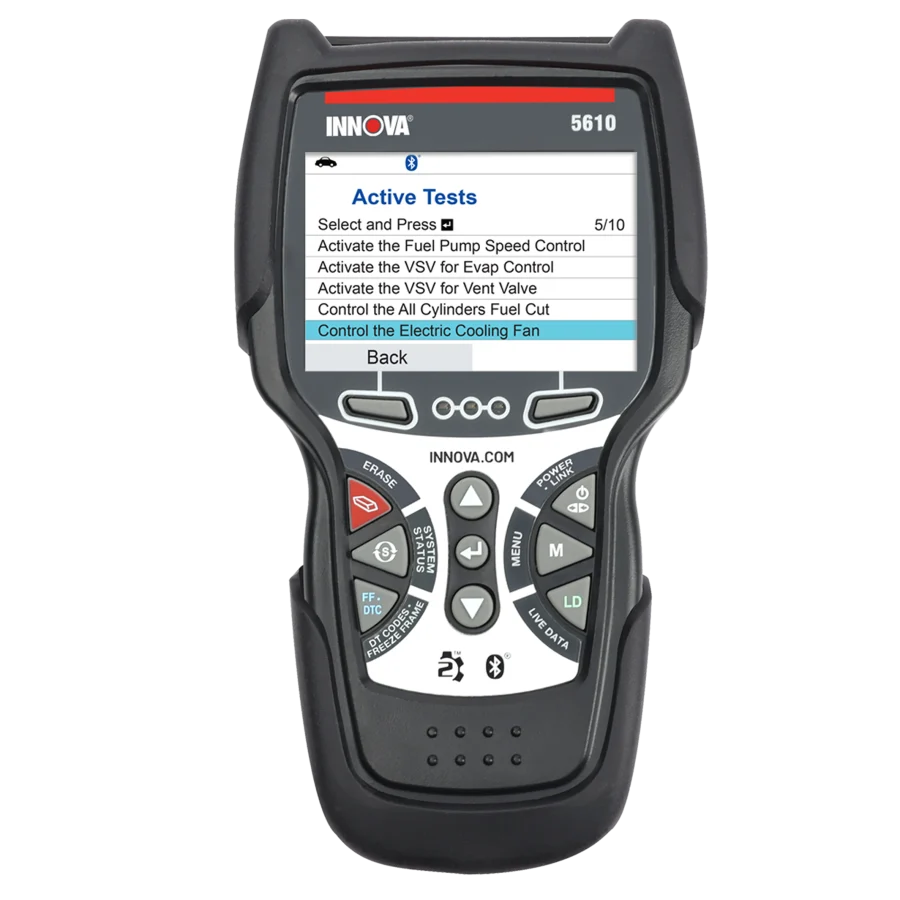
Innova’s published master feature chart names transmission-temperature information and OEM live data for engine, ABS, SRS, and transmission on the 5610. Its 2026 product materials also discuss transmission resets and fluid-level checks among vehicle-dependent routines. This is unusually specific manufacturer evidence for a handheld at the feature-category level. The limitations matter just as much: not every operation is available on every vehicle.
When it fits: owners who want to view supported transmission information and prefer a standalone device rather than a larger tablet. Before buying: run Innova’s coverage checker for the exact year/make/model and requested TCM functionality, and confirm whether a listed “transmission reset” actually corresponds to the factory procedure you need.
Do not mistake support for a feature family for permission to perform it. A shop may need additional scan data, a test drive, a service manual, or specific specialized equipment. The 5610 is a candidate, not a universal transmission repair instrument.
2. Autel MK900-BT — all-system diagnostic tablet

Autel’s manual identifies transmission among vehicle electronic systems accessible under its diagnostics menu, along with engine and ABS. Its product specifications list DTCs, live data, ECU information, active tests and pre/post scan reporting. Those features can support a documented troubleshooting session when the TCM is within the car’s coverage.
When it fits: a household maintaining multiple cars or a small garage that needs broader fault investigations. Before buying: confirm the actual TCM module and requested live-data parameters, not only generic “all-system” capability. A special adaptation may require permissions, software, or a prescribed service sequence.
3. XTOOL D7S — wired diagnostics with advertised transmission module access

XTOOL’s official D7S page lists Transmission among systems and describes active tests and data display. Its wired format may be preferable during a prolonged stationary inspection. It also advertises CAN FD and DoIP platform support, which matters only if the target vehicle and control-unit workflow require them.
When it fits: someone who wants broad general diagnostics and already knows the transmission functions they need. Before buying: verify the 2026 model version, regional software, TCM coverage, update policy and whether the required job is an active test versus an adaptation. XTOOL’s US-specific VAG Guidance restriction makes exact guided-function verification especially important on affected vehicles.
4. XTOOL D8S — wider diagnostics for multi-module investigations

The D8S adds functionality such as topology mapping and an expanded service catalog in the manufacturer’s positioning. This can be useful when a drivability complaint involves network communications or multiple controllers, not simply a transmission code. A topology view can show communication structure, but it cannot confirm internal transmission condition.
When it fits: repair-focused users who have a separate reason to need topology or a broader function set. Before buying: check the same specific TCM functions you would verify on a D7S. The extra price is difficult to justify if the exact job is supported identically on the cheaper device.
5. TOPDON ArtiDiag900BT — broad maintenance and live-data platform

TOPDON lists all-system scans across a wide brand selection, with data streams, 28 service categories, and bidirectional controls. It is a reasonable product to examine for multi-vehicle ownership, but its product page does not establish that a particular transmission fluid-level routine works on an unlisted car. The advertised function count is not a substitute for checking TCM software coverage.
When it fits: buyers with numerous service tasks beyond transmission fault codes. Before buying: request exact TCM coverage and calculate update costs if keeping the tool for several years. TOPDON lists two years of included updates and optional annual renewals for this model at the time of research.
6. TOPDON Phoenix Lite 2 — shop-oriented diagnostic candidate
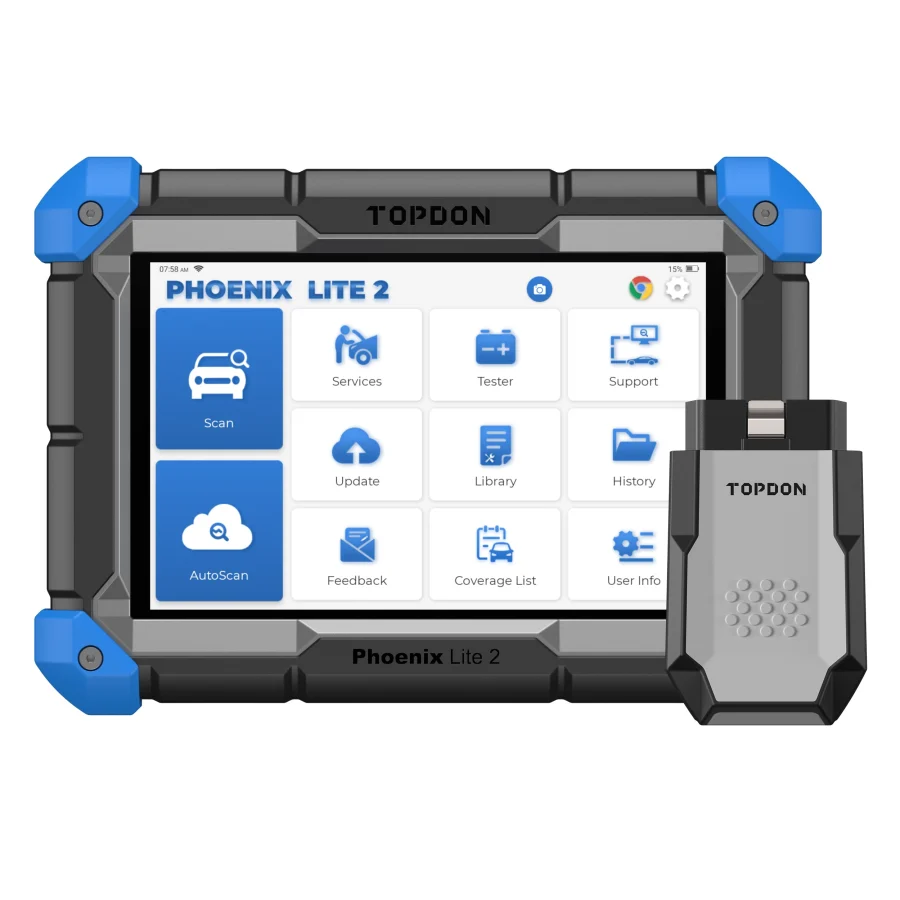
TOPDON positions Phoenix Lite 2 as a higher-end all-system diagnostic tablet, naming transmission and other controllers in its official US description. The product page also groups advanced functions, protocols and access under distinct sections. Its place on this list is a candidate for deeper documented checks, not a claim that every programming or transmission adaptation function works on every vehicle.
When it fits: a small workshop needing a broader diagnostic platform. Before buying: verify device generation, bundled VCI, exact regional variant, update costs, and authorized access for the desired function. Don’t automatically infer J2534 pass-through capabilities from a generic scanner feature description.
Interpreting transmission data responsibly
A TCM live-data stream can include commanded gear, vehicle speed, input or output speed, fluid temperature, or other values if the vehicle exposes them. A single snapshot rarely establishes why a shift problem occurs. Some values must be considered under specified conditions such as gear, temperature, load, or drive cycle. Never invent “normal” numerical thresholds without the specific transmission’s service specifications.
Diagnostic example without fabricated numbers: Suppose one scan provides a generic powertrain fault but no TCM communication. A better purchasing path is to verify a tool that can read that transmission controller, then compare any real data against the service document’s expected operating conditions. It is not appropriate to infer from that scenario that a solenoid or valve body must be replaced.
Fluid-level procedures can be especially model-specific. The reader should follow the factory instructions for vehicle position, temperature window and safety precautions. A scanner displaying temperature does not itself establish the correct filling procedure. If the car has drivability or safety symptoms, a qualified specialist should evaluate it.
Selection methodology and reasons for the shortlist
These six models were included because their manufacturers describe all-system or transmission-related diagnostics and because the group covers a meaningful range of ownership workflows: handheld, mid-range wired or wireless tablet, and more shop-oriented equipment. The ranking is not built on invented road tests, inferred vehicle failure rates, or a presumed relationship between price and accuracy. Exact transmission function support remains the reader’s primary purchase gate.
A useful scanner recommendation must answer four independent questions: Can the tool access the intended transmission control module? Can it retrieve the specific codes or data needed? Does it support any required active test or special function on that controller? And does the buyer have a legitimate, documented way to perform the related service operation? A scanner may pass the first two gates and fail the last two. That can be perfectly acceptable for an initial diagnosis, but not for a reader seeking a manufacturer-required adaptation.
The six models illustrate this range rather than representing a claim that they are the six top-performing scanners in the market. We did not purchase units, measure refresh rate, run controlled TCM active tests or verify failure resolution. Current manufacturer documents are our evidence for considering each candidate; vehicle-specific results must be obtained before a final personal choice.
Generic P-codes versus enhanced transmission diagnostics
A vehicle may report a generic fault through the engine or powertrain system even when the detailed diagnostic information resides in the TCM. A budget reader that reports a broad transmission-related code may tell the owner that the vehicle needs further diagnosis, but it may not offer the manufacturer’s specific TCM code, related live parameters or status. This is a fundamental reason a more capable device can have value.
However, “enhanced” is not synonymous with “complete.” Software packages vary by vehicle and by what information the automaker makes available. An aftermarket tool may have a transmission module menu for one make and not another; it may read codes for the module but offer limited live data; it may list a reset without the exact required calibration. Ask support for the specific feature, not an unqualified answer about “transmission diagnostics.”
A helpful comparison table for the buyer’s personal research would have columns for the vehicle’s exact engine/transmission code, TCM fault-code access, requested temperature or pressure PID, desired active test or adaptation, and manufacturer-confirmed notes. Leave unconfirmed cells blank instead of substituting guessed yes/no values.
Three practical buying decisions
Owner checking fluid temperature on a specific automatic transmission
Some transmissions use temperature-specific fluid checks. The buyer needs a scanner that can display the relevant measured temperature for that car; a generic engine coolant reading is not a substitute. Begin with the official fluid-level procedure and note which transmission parameter it specifies. Then confirm the scan tool exposes that exact value. Innova’s published 5610 materials list transmission temperature among its feature categories, which makes it a plausible check, but still not universal support.
This buyer may not need topology maps, online coding or a long maintenance menu. A well-supported handheld could be more practical than an expensive tablet. Yet the tool does not define the service conditions or substitute for the transmission manufacturer’s filling procedure.
Multi-car owner investigating codes and live data
A person maintaining several vehicles may value consistent reporting, screenshots and the ability to move between engine and TCM modules. Autel’s all-system MK900-BT and XTOOL’s D7S are plausible research candidates, subject to the exact module support. Compare the real cars and known tasks, not a percentage of worldwide vehicles. An older sedan and a newer vehicle using CAN FD or DoIP may have different communication requirements and software coverage.
The owner should also think about how long the scanner will be used. Hardware with included updates for a certain period can be economical for a stable fleet, while a device with shorter free coverage may require more frequent paid upgrades if the fleet changes. Ongoing costs belong in the decision, not only the first product price.
Professional technician diagnosing a multi-module fault
A shop handling complex complaints might benefit from documented module topology, pre/post reporting and broad live data. A higher-tier XTOOL or TOPDON tablet may warrant investigation for these workflows. But a topology diagram is a map of reported electronic communications, not a mechanical inspection of the transmission. It does not establish a failed part or eliminate the need for pressure tests, factory diagnostics or mechanical assessment.
Professional buyers should obtain written confirmation for the supported TCM, its specific procedures, current authorization requirements and export formats. Compare all of that with an OEM tool option. Not every independent repair shop is best served by an aftermarket all-in-one tablet for every job.
Data interpretation: the difference between observing and concluding
Transmission-fluid temperature: a reported number is useful only if it represents the specified sensor and the vehicle’s service instructions define a legitimate operating range for the intended procedure. Never invent a universal “correct” temperature across transmissions.
Commanded gear versus observed behavior: a tool may report commands and related inputs, but interpreting discrepancies demands knowledge of the gearbox, sensors and operating state. One conflicting reading could result from an electrical, hydraulic or mechanical condition. It is not a conclusive part diagnosis.
Input and output speed values: a scanner may expose signals useful for technical analysis, but their relationship depends on selected gear, clutch state and system strategy. Interpret those signals with the vehicle’s service data and the specific transmission’s operating strategy; a generic numerical threshold cannot establish an internal fault.
Adaptation counters or learned values: some transmissions adjust behavior over time. The existence of a reset button does not mean it should be used before diagnosis, or that it will correct abnormal shifts. Manufacturer procedures and prerequisites remain essential.
Purchase cost versus the cost of being wrong
Before clicking an affiliate link, distinguish a useful scanner expense from a speculative one. A lower-cost scanner that can retrieve your required TCM code may be all you need for the first stage. If the job requires a manufacturer-controlled programming session, an aftermarket diagnostic tablet alone may not be sufficient even at a much higher price. This is why our J2534 guide separates pass-through programming from ordinary bidirectional functions.
Also check software renewal costs. Compare the period of included updates and the cost of retaining coverage for newer vehicles over three to five years. Avoid treating optional renewals as mandatory for every owner, but don’t ignore subscriptions when the intended service requires active access. For a stable personal vehicle, keeping the installed functions may suffice; for a business serving new model years, updates may be central to the business case.
Finally, be cautious with used scanner listings. Missing VCIs, unavailable regional registration, ineligible warranties and unclear account transfers can undermine any advertised discount. Ask for exact part identities and authorized support before assuming a bargain.
How to ask for a definitive compatibility answer
Provide manufacturer support a compact request: I need to read TCM DTCs and see [specified parameter] for a US-market [year, make, model, engine/transmission]. Does scanner [exact model/SKU] with current US software support the TCM and named function? Does it need a separate adapter, subscription, or OEM authorization? Can you confirm the menu path or covered function name?
An answer that only says “all systems supported” does not establish access to the controller and parameter you need. Ask for the precise TCM function, supported vehicle configuration and any regional or software limitation. Save the response with the purchase record so you can compare the delivered tool with the capability that justified the order.
Purchase checklist
Record the vehicle, engine/transmission variant and market, then identify whether you need TCM codes, a particular PID, temperature data, an active test, an adaptation or module programming. Check the exact scanner SKU against current manufacturer coverage. Ask about required gateways, accounts and accessories. Save the written answer and match the seller’s selected product to it before ordering.
Use our J2534 vs bidirectional scanner guide when a repair order mentions module programming, not simply TCM diagnostics. The live-data primer explains why sensor PIDs and freeze-frame values need context.
A final verification matrix before checkout
For every scanner under consideration, write a row containing its exact US model number, the vehicle’s engine and transmission variant, confirmed TCM DTC access, the particular OEM temperature or status parameter requested, a named adaptation if applicable, the most recent official coverage date, and an open question to support. A blank cell means unverified, not “yes.” This matrix can prevent buying a tool that excels at engine diagnostics yet lacks the one module or service routine that motivated the purchase. If no manufacturer substantiates the requirement, defer the affiliate purchase recommendation and consult an appropriate repair specialist.
One more safeguard: Ask the seller to identify the exact US-market product revision on the order receipt and ensure the manufacturer can support it. A photo of a similar model, a brand-level compatibility claim, or an unsourced “all transmissions” promise should not be considered approval. If a transmission symptom suggests unsafe vehicle operation, stop driving and seek qualified assessment rather than treating a scan as permission to continue.
Frequently asked questions
Does a normal OBD2 scanner read transmission codes?
Some emission-related powertrain codes may be available, but that is not the same as enhanced TCM access. Confirm the exact diagnostic category on your vehicle.
Can a scanner repair hard shifts?
No. It can provide diagnostic evidence or perform a supported manufacturer-defined routine, but cannot repair a worn or damaged mechanical component by reading codes.
Is a transmission reset safe to use whenever shifting feels strange?
Do not assume so. Adaptations and resets may require specific preconditions and can alter learned behavior. Use current vehicle service instructions and professional advice where necessary.
Will a more expensive scanner read additional transmission data?
Possibly, but not automatically. Confirm exact PIDs and commands for your particular car before paying for higher hardware tier.
Final recommendation
Innova 5610 is a sensible coverage-checker-first handheld candidate; Autel MK900-BT and XTOOL D7S are compelling all-system research leads; D8S, ArtiDiag900BT and Phoenix Lite 2 merit evaluation when larger work scope is justified. The best scanner is the one whose manufacturer verifies your exact TCM operation, not the device with the longest advertising page.


